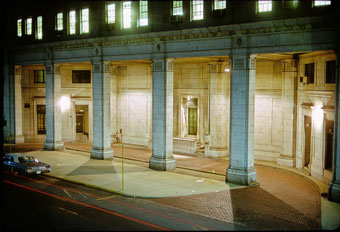
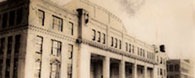
At the start of World War II, the United States Army bought Paramount's motion picture studio at 35th Avenue and 35th Street in Astoria, Long Island City, Queens, New York, taking over in February 1942.  The studio became the Signal Corps Photographic Center, later Army Pictorial Center, home to filmmakers and still photographers who covered the war and who produced countless training films.  This is the story of the people who served there.


Help Requested


Personnel Roster


Films


Images


Memories


APC on the Web


After APC


Other Photo Units


Books


Contributors


Search


Contact


TV host detained

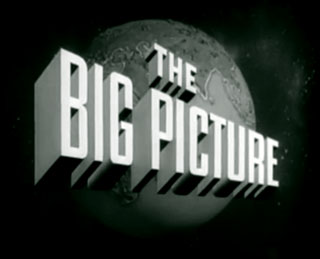
Master Sergeant Stuart Queen is detained and escorted from the set of The Big Picture in an episode of the Army's weekly television program dramatizing the Army's war gaming.  Peter Anderson asked, "I vaguely remember the host of 'The Big Picture' being escorted from the set by military or Pentagon police, and the episode going to commercials. Did this occur, and when and to whom if it did occur?" Stephen Brittenham of Albuquerque supplied the answer, with a link to YouTube. "I think this may be what he is referring to: http://www.youtube.com/watch?v=Eczdl5pBiFg&feature=related." This episode, "The Aggressor," appears twice in The Big Picture catalog at TV 362 and TV 555. 

The Big Picture Catalog
"Is there a comprehensive list of when each episode of The Big Picture was released?: asked John Simpson of Kennesaw, Georgia.  "I see on the website an occasional reference to episode so and so being in the 1962-63 season."  The answer is a partial "yes."  A compilation of annual catalogs of episodes of The Big Picture lists production numbers, titles and in many cases other information, but the list is still incomplete.  Click here to see the catalog.

Cameraman Bernard J. Shapiro
"Did a SHAPIRO,BERNARD J. ever work as an Army cameraman in Vietnam?" asked Roger Hawkins, formerly with the 221st Signal Company (Photographic) in Vietnam.  "Looking for a guy that filmed the return of a rescued Air Force pilot."  Shapiro is listed on our Personnel Roster with Studio Branch, but we don't have any more information.  It you can answer the question, send an e-mail to the Webmaster.

Cameras for atomic tests

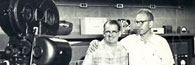
Coverage of atomic tests in the 1950s was a classified assignment for Army Pictorial Center personnel.  Ernest C. Baumert helped make it a success.  As chief of Maintenance and Engineering Branch for APC, Baumert designed the remote, sequential camera array and operated cameras at the tests.

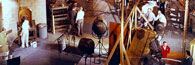
Baumert with a camera in the maintenance and engineering shop.


Yesterday's Headlines

Headlines, stories and photos that previously appeared on this home page may have moved to Yesterday's Headlines, where you can still find helpful links.

Commander's secretary

 Sgt. Bilko

Main Stage

Television

Who was Norton S. Parker?


APC / SCPC


Help!

Yes, we still need your help to answer the questions about SCPC/APC and films made there. 

Is that Truman Bradley showing us how to select and pack an animal in 1943 training films?

A WWII re-enactor seeks information about Signal Corps Field Caption Cards.

"It is quite rare and information is scarce."  Someone has acquired a WWII Oneida Photographic Lab Trailer and is seeking information, manuals, or photos.

It isn't an SCPC connection, but an Army photograph led Lisa R. Gerardi  here in her search for records made by her grandfather, PFC Bernie Rattet.

Who was Jerry, the editor on "Public Shelter Living: The Story of Shelter 104"?

Was Dorothy McManus the original Emmy, the model for television's top award?

Did anyone ever respond to the a question about the film, "Invasion of Poland," asks researcher Jeff Grehan.

See if you can answer any of the questions on the Help page.

Artifacts sought

Alumni of Signal Corps Photographic Center / Army Pictorial Center have been asked to donate artifacts to the collection at the Museum of the Moving Image.

Collection Curator Barbara Miller wrote, "We would be very interested in collecting 'artifacts' from former SCPC/APC staff. These would include cameras (not necessary that they be in working condition) and other technical equipment, photographs, scrapbooks, manuals, or any other objects used in the production or promotion of media created by the military. We have a fairly significant group of objects related to the APC in our collection, and are committed to preserving APC history through collecting and exhibiting this material. Please note we do not collect moving image media (i.e. film and video), only objects related to their production, promotion, and exhibition."

If you have artifacts you can offer to the museum, send a note to this site's Webmaster.

Visit the museum website at
http://www.movingimage.us/


Friday, April 06, 2012 12:51:45 PM

Hit Counter