 |
|||
|
Memories Everyone who spent any time at Army
Pictorial Center has a story to tell. We welcome notes from anyone who
was assigned to APC, worked there, appeared in any of the productions,
or just visited. What's you're favorite memory?
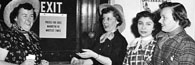
Jack Stuart Ott and his wife, Phyllis,
appeared in pictures of a boat trip and a Halloween party, apparently
from Army Pictorial Center in the 1950s. The pictures, supplied by
his daughter-in-law, Katherine Ott, show other, unidentified personnel,
but the pictures typify the relaxed, off-duty comaraderie among those
stationed at APC. Joseph Henabery was a
director at the time 1LT Norman N. Mintz was at Army
Pictorial Center. "Joe was a long-time movie pro. He was an actor in the
teens and twenties, played Abe Lincoln in "Birth of a Nation" (you can
google him) and a director in the early days of film. I don't know when
he went to work at APC or how long he stayed after I left. I worked with
him on 'The Big Picture for Christmas, 1956'."
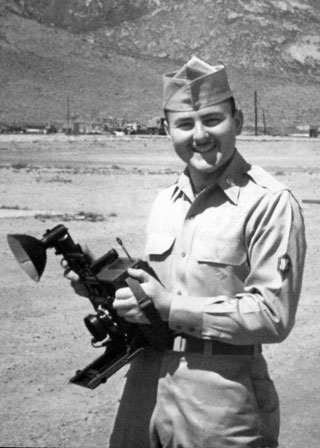
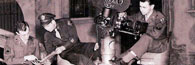
PFC Arnie Gliner was a still photographer and worked in the still photo lab at Army Pictorial Center. Arnie provided this 1957 photo: "While stationed at APC, I was sent to White Sands Proving Grounds TDY."
Rita (Baducci) Pinchiaroli's grandson Aldo Burrascano wrote, "My Grandmother, Rita Pinchiaroli (though it was Baducci before she was married in 1946), worked as a Film Editor in the Editorial Department at the Army Pictorial Center. She first went to work there during WWII (she says either 1942 or 1943) and left in 1947. She then returned sometime in the mid-to-late 1960s as a Film Inspector, and remained there until it closed. We were talking about her job there when she asked if I could find out when it was first opened. We came across your site and it brought back a lot of memories to her. She recalls many of the people listed as working in the Editorial Department. I've attached a photo of what she looked like in the 1940s." Kurt Volkert wrote, "I was a S/Sgt and cameraman at APC from about 1962 till 1967 in Joe Lipkowitz's department when I joined CBS news as a cameraman and later producer. I retired after 27 yrs from CBS and live now in Germany. I remember Joe as a very kind and thoughtful and able boss to whom I will be forever grateful for his many kindnesses. Without my activities at APC I would not have gotten the CBS job which later defined my life. (Posted 011709)
SP5 Marty Welsch
served in Cost Accounting & Data Processing, 1961 to 1963. Former SP4 Richard E. Goodwin wrote, "I took advance training at Fort Monmouth, NJ and then was stationed at the Pictorial Center in LIC for about 2 or 3 months in 1957. 20 of us were sent from LIC to Fort Ord California to set up a photo lab there since they did not have one at the time. I was in the Army from 1957 to 1963. I met someone today who was stationed at APC in the 60s and he directed me to your site. I am at: 7 Henry Avenue, Sanford, Maine 04073, 207-324-2867." Richard Krachun wrote, "In August 1959, I arrived at APC as a Pfc. serving in the TV repair barracks behind the main building. I was later transferred to the B&W mobile TV van and later to the Color TV van. I was separated as a Spec. 5 in August 1961. I lived in the building across the street and enjoyed my 2 years there. I am sorry that I never went back to visit before APC closed." Sharps Rifle and Pistol Club, a report by Joe Lipkowitz in the December 1968 issue of In Focus: The Sharps Rifle and Pistol Club elected the following officers for 1969:
At the meeting a club insignia was agreed upon and steps taken to produce it. The two meetings at the Rifle and Pistol Ranges at Fort Tilden were exciting and productive. The club now boasts approximately 45 members, and it is contemplated that new membership will soon be closed.
"The update on Sgt. Calicchio was interesting to hear," wrote
Howard Rieder. "I remember him well; he was our first
sergeant. The thing I remember best was that we were often treated
to him taking out his glass eye in the latrine and washing it off.
Not necessarily a pretty sight, but true."
"Stumbled on to this site from a Google search. The names and photos
bring back great memories of my wonderful years at APC," writes
Steven R. Gilman (stevengilman@msn.com), First Lieutenant
(Signal Corps,) who was an assistant director for Harry
Cunningham in Directors Branch from October 1964 to February
1966.
"I was on travel with Major Pleas
Perry and Private First Class Budworth in
sunny Hawaii," remembers then-Specialist 5 T. Adams,
"and then to the 'island with a woman behind every tree'; there were no
trees on this manmade island.
APC
was a terrific and for me, unforgettable place." Robert H Lehner, who served as a corporal in the 2nd Signal Photographic Platoon from April 1952 to October 1953 as a still photographer, recalls, "When I served there the [2nd Signal] CO was Capt. Stanford Roberts. Later he was replaced by LT. Warren R Corville. At that time we had about 30 or 40 enlisted men and a like number of officers. A great place to do your army service."
"When I served there the {2nd Signal
Photographic Platoon] CO was Capt. Stanford Roberts.
Later he was replaced by LT.
Warren R Corville.
At that time we had about 30 or 40
enlisted men and a like number of officers. A great place to do your
army service."
- Robert H Lehner
Cpl.
2nd Signal Photographic Platoon, April
1952 to Oct. 1953, Still Photographer
Harold Hudnell of Chester,
Pennsylvania, wrote:
I was at the center around 1961 with a
group of entertainers from Ft. Jay, New York. We made a motion picture.
Our song and dance group was the First Army's best. The action started
off as play then song and dance.
I remember the name of the scene as
THE SOFT SHELL SOAP CORPORATION. We were part of the USO. My name is
HAROLD HUDNELL 165653654. Can you locate this film? (If you can, send
information to Webmaster.)
Actor Christopher Walken
said, "And you know now there is the Kaufman Studios where Woody Allen
makes his movies. Before that it was the Army Pictorial Center, and when
I was 18 years old I made training films there."
He was talking, with singer Cindi
Lauper, about a recent movie they made.
"Training films? What are training
films?" Lauper asked.
"How to replace a tread on a tank or
how to make your bed," answered Walken, who began as a child actor on
live TV soaps in the early '50s, was then known as Ronald or Ronnie
Walken.
Laurie Rader Siegel remembers:
My father, Martin Rader, worked at Army Pictorial Center from
1947 to 1970. He was a sound engineer. My dad loved going to work. He
enjoyed what he did and loved the people he worked with. I went to work
with him from time to time, and I could see how all the employees
felt like a family. There are certain employees that I remember. One was
Herman Korman. He was responsible for the boom. I also remember
Harry Noack. He was a cameraman. Another person I remember is
Ezra Gold. He was very kind, with a great sense of humor.
My father worked at the center for 23 years-until the day of it's
closing. In 1970 Former President Nixon decided to cut down on
government spending. Unfortunately, he decided to close the Army
Pictorial Center. What a sad day it was for many employees. Their
"family" had now vanished. Updated June 10, 2019.
|
|||
|
|
|
|
|
|
|
|
|
|
|
|
|
|
|